

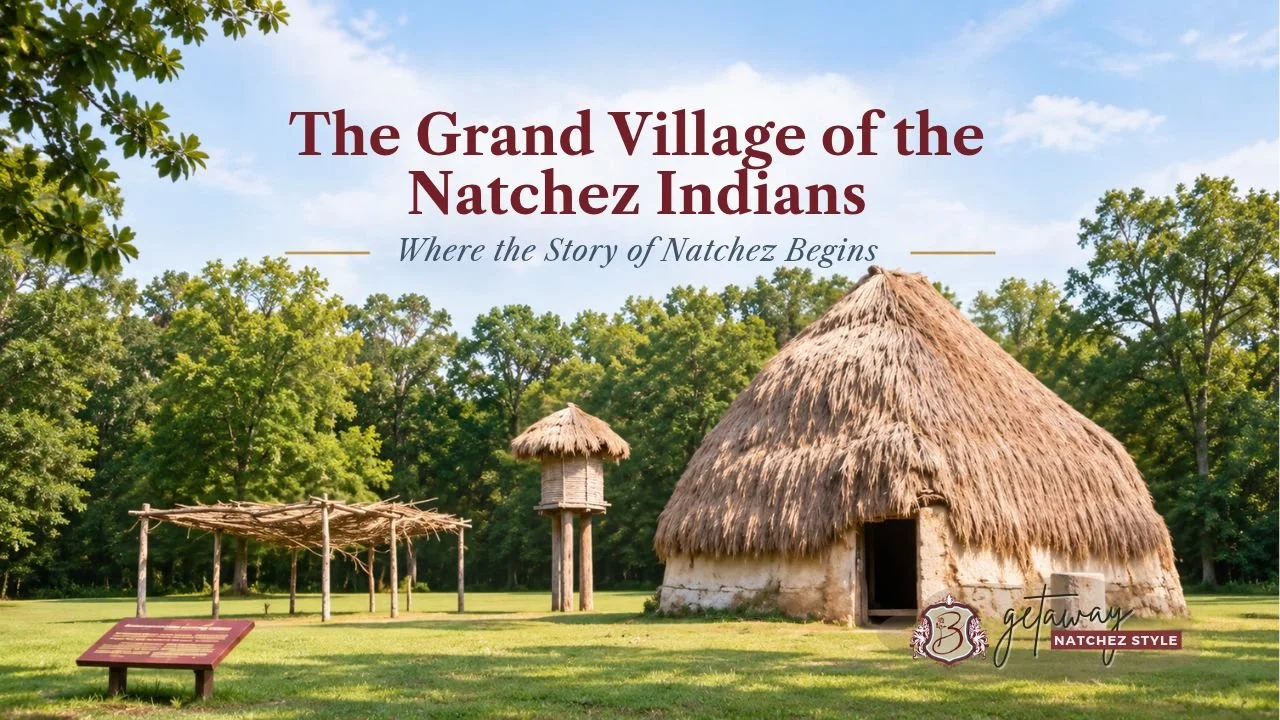
The Grand Village of the Natchez Indians: Where the Story of Natchez Begins
Just a short drive from downtown Natchez, the Grand Village of the Natchez Indians preserves one of the most important places in the region's Indigenous history. Long before the historic homes and streets familiar today, this was a center of political leadership, religious ceremonies, and community gatherings for the Natchez people.
Situated along St. Catherine Creek, the site served as the Natchez people's principal ceremonial and political center during the late seventeenth and early eighteenth centuries. Today, its surviving earthen mounds, museum, and grounds offer visitors an opportunity to explore a chapter of Natchez history that began centuries before European settlement.
The Historical Significance of the Site
This was more than a collection of ceremonial mounds. It was an important center of leadership and religious life within a society whose communities and agricultural settlements extended across the surrounding region.
The Natchez were governed by hereditary leaders, including the Great Sun, who held an important political and ceremonial position. Historical accounts identify his residence atop one of the mounds, while another supported a temple associated with religious practices and ceremonies.
Of the six mounds documented on an early eighteenth-century French map, three remain visible today. Two of these, known as the Great Sun's Mound and the Temple Mound, have been excavated and restored to their documented dimensions.
Archaeological investigations have also uncovered pottery, evidence of buildings, and other materials that help researchers understand the people who occupied and used the site. The discoveries complement early French descriptions, providing a fuller picture of this important place in Natchez history.
What Happened to This Ceremonial Center?
When French explorers arrived in the region during the late seventeenth century, the Natchez people had already established a complex society with longstanding cultural traditions.
Relations between the Natchez and French colonists became increasingly strained as colonial settlement expanded. Disputes over land and other conflicts eventually led to war in 1729.
In 1730, French forces and their Indigenous allies besieged the ceremonial center, and the Natchez abandoned the site. The conflict brought devastating consequences, including the displacement and enslavement of Natchez people.
Although this location ceased to function as their principal ceremonial center, the Natchez people did not disappear. Their descendants and communities continue today, preserving connections to their history and cultural identity.
Exploring the Site Today
The Mississippi Department of Archives and History preserves the Grand Village of the Natchez Indians as a 128-acre historic site, with three visible mounds, a museum, and a nature trail.
The museum introduces visitors to the Natchez people through exhibits and archaeological interpretation. Outside, the surviving mounds and open grounds provide a sense of the site's original setting along St. Catherine Creek.
One of the most worthwhile aspects of visiting is seeing the landscape alongside the historical information. Understanding that important buildings once stood on these earthen platforms changes the way visitors see the mounds. They were part of a functioning community, shaped and maintained by generations of people.
Admission and parking are free, making this an accessible addition to a day of exploring Natchez.
Understanding Natchez Through the Grand Village
Natchez is well known for its nineteenth-century architecture, but its history reaches much further back. The Grand Village of the Natchez Indians provides a tangible connection to the Indigenous people whose homeland existed here long before the city's familiar landmarks.
The site also reminds visitors that understanding history requires looking beyond the buildings that survive. Archaeological evidence, historical documents, and the continuing experiences of Natchez descendants all contribute to a fuller understanding of this place.
A visit is a worthwhile starting point for anyone interested in discovering the deeper history of Natchez. For guests staying at Beaumont House Bed & Breakfast, the site is easy to include in a morning or afternoon of exploring the area.
Plan Your Visit
Grand Village of the Natchez Indians
400 Jefferson Davis Boulevard
Natchez, Mississippi 39120
Hours:
Monday–Saturday: 9:00 a.m.–5:00 p.m.
Sunday: 1:30–5:00 p.m.
Admission and parking: Free
Telephone: 601-446-6502
Official website:
https://www.mdah.ms.gov/explore-mississippi/grand-village-natchez-indians
The Grand Village is located just off U.S. Highway 61 on Jefferson Davis Boulevard, a short drive from downtown Natchez.
Part 2 of 4: Discovering the History of the Natchez People
Continue Exploring: Emerald Mound: Exploring Native American History Near Natchez, Mississippi