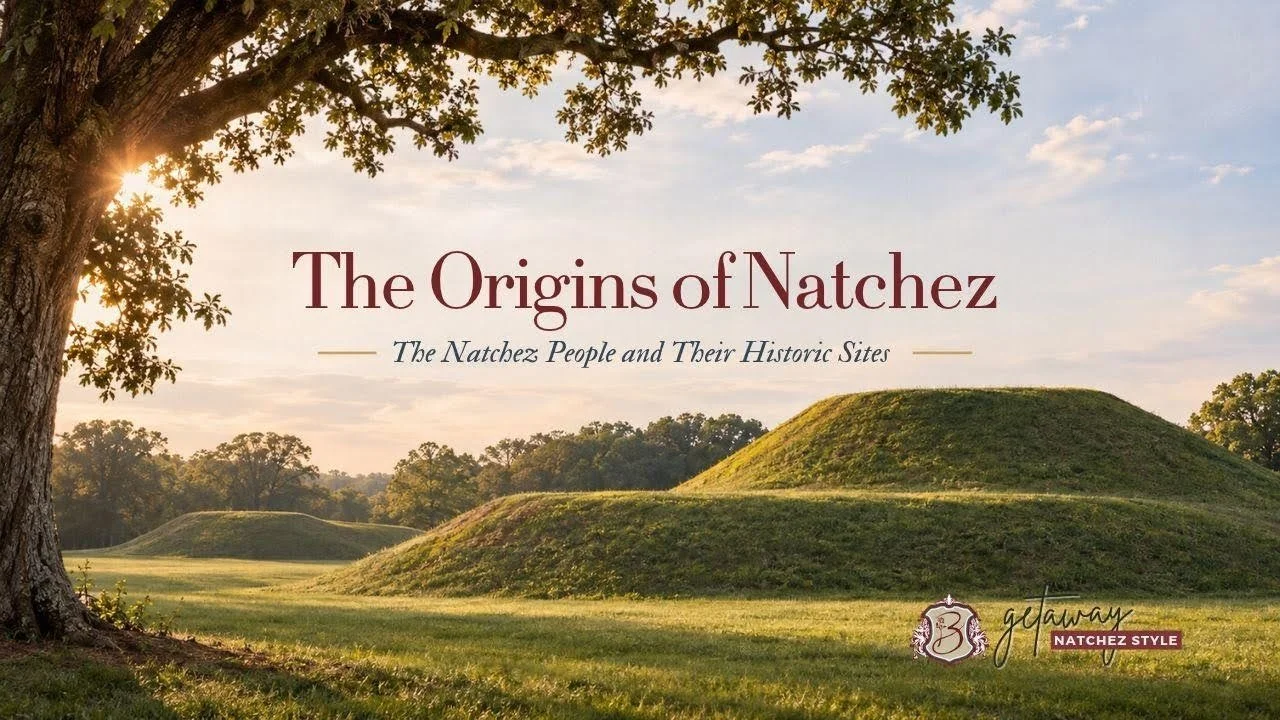
The Origins of Natchez • Part One
The Natchez People and Their Historic Sites
Long before Natchez became known for its antebellum homes, river views, and Southern history, this land was home to the Natchez people. Their history reaches back centuries, long before the arrival of European settlers, and remains an essential part of understanding Natchez, Mississippi, today.
The Natchez were part of a much older tradition of Indigenous communities living along the lower Mississippi River. Their ancestors developed agricultural settlements, built earthen mounds, and participated in the cultural traditions of the Mississippian world. They grew corn, beans, and squash, hunted and fished, and maintained a complex society with political and religious traditions that influenced community life.
Among the most important surviving places associated with this history are the Grand Village of the Natchez Indians and Emerald Mound. Both are within a short drive of downtown Natchez, and each offers a different perspective on the people who lived here centuries ago.
The Natchez People and Their Mound-Building Traditions
The earthen mounds found throughout the lower Mississippi Valley were much more than large piles of soil. Constructed over generations through organized community labor, many served as elevated foundations for important buildings and as centers of ceremonial and political life.
The Natchez maintained a distinctive social and political organization. Leadership was associated with a hereditary position known as the Great Sun, while family descent followed the maternal line. Historical accounts and archaeological discoveries have helped researchers understand these traditions, although important questions remain about daily life and the meanings of particular ceremonies.
Most Natchez people did not live permanently at the ceremonial mound centers. Many lived in smaller settlements and agricultural communities, gathering at important sites for religious, civic, and social occasions.
Two places near present-day Natchez help illustrate this history.
The Grand Village of the Natchez Indians
Located on Jefferson Davis Boulevard, just a short drive from downtown, the Grand Village of the Natchez Indians was the principal ceremonial and political center of the Natchez people during the late seventeenth and early eighteenth centuries.
The site lies near St. Catherine Creek and preserves three visible earthen mounds. Archaeological investigations have identified the remains of structures associated with leadership and ceremonial activities, including the Great Sun's residence and a temple. Excavations have also revealed pottery and other evidence of the community that once gathered here.
Today, the Grand Village is administered by the Mississippi Department of Archives and History. Its grounds, museum exhibits, and interpretive resources offer visitors an opportunity to learn about the Natchez people and the significance of the place.
The state has also introduced the name Natchez Tribal History Center as part of its plans to expand and improve the site's interpretation in consultation with tribal communities and scholars.
Emerald Mound: An Earlier Ceremonial Center
A little farther north, near the Natchez Trace Parkway, Emerald Mound provides another remarkable connection to the region's Indigenous past.
Covering approximately eight acres and rising about 35 feet above the surrounding land, Emerald Mound is one of the largest surviving Mississippian ceremonial mounds in the United States. Its enormous earthen platform and the smaller mounds constructed above it represent an extraordinary undertaking, accomplished without modern machinery.
Archaeological evidence connects Emerald Mound with the Mississippian cultural traditions from which the historic Natchez emerged. Researchers have suggested that it may have served as an important ceremonial center before the Grand Village assumed that role.
The site is preserved by the National Park Service along the Natchez Trace Parkway. Visitors can appreciate its scale from the designated visitor areas and learn about its construction and ceremonial significance through park interpretation. The mound should be treated with respect as a culturally significant Indigenous site.
A History That Continues
The Natchez people's history did not end with the construction of their mounds, or even with their departure from the land surrounding present-day Natchez.
As French colonists expanded into the region during the early eighteenth century, disputes over land, resources, and political relationships led to increasingly serious conflict. Warfare beginning in 1729 brought devastating consequences for the Natchez. By the early 1730s, survivors had been killed, captured, enslaved, or displaced from their homeland.
Some found refuge among the Chickasaw, Cherokee, and Muscogee (Creek) peoples, while others established communities elsewhere in the Southeast. Natchez descendants and communities continue today, including in Oklahoma and South Carolina.
Remembering this continuity matters. The mounds are important archaeological and historic places, but they represent only part of the history of a people whose identity did not disappear when their homeland came under colonial control.
Visiting Natchez's Indigenous Historic Sites
The Grand Village and Emerald Mound offer two different ways to explore this important chapter of Mississippi history.
At the Grand Village, museum exhibits and the preserved landscape help explain the Natchez people's ceremonial and political life. Emerald Mound offers an opportunity to appreciate the scale of an earlier mound-building tradition and the extraordinary work involved in creating these structures.
Together, the sites provide a broader understanding of Natchez, one that begins long before the historic homes and streets familiar to many visitors today.
For travelers staying at Beaumont House Bed & Breakfast, both locations are within reach of a morning or afternoon dedicated to exploring the area's history.
Plan Your Visit
Grand Village of the Natchez Indians / Natchez Tribal History Center
400 Jefferson Davis Boulevard
Natchez, Mississippi 39120
Published hours:
Monday–Saturday: 9:00 a.m.–5:00 p.m.
Sunday: 1:30–5:00 p.m.
Admission and parking: Free
Telephone: 601-446-6502
Official visitor information:
https://www.mdah.ms.gov/explore-mississippi/grand-village-natchez-indians
Emerald Mound
Natchez Trace Parkway, Milepost 10.3
Approximately 10 miles northeast of Natchez, Mississippi
Follow Emerald Mound Road for approximately one mile from the Parkway to reach the parking area.
Admission: Free
Visitors should follow current National Park Service signs and restrictions and respect the site's ceremonial significance. Do not climb onto the mound.
Official visitor information:
https://www.nps.gov/natr/learn/historyculture/emeraldmound.htm